

What is the safety diamond or NFPA 704 diamond?
crucial tool for the identification of chemical risks
What is the safety diamond or NFPA 704 diamond? The safety diamond, also known as NFPA 704 Diamond, is crucial for identifying chemical hazards and ensuring safety in industries handling hazardous materials. This article explains what the safety diamond is and how it is used under the regulations NFPA 704, the meaning of each of its colors and how it is implemented in different industries to prevent accidents. We will also discuss who is responsible for overseeing its use in companies and the importance of ongoing training in its proper implementation.
What is the NFPA 704 safety diamond?
The NFPA 704 safety diamond is a hazard identification system developed by National Fire Protection Association (NFPA) of the United States. Its purpose is to provide clear, visual warnings about the risks associated with different chemicals, enabling workers and emergency response teams to assess the hazard level quickly.
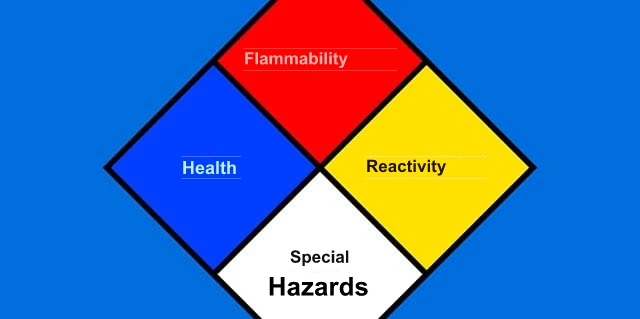
The diamond uses colors and numbers to indicate the severity of health, flammability, reactivity and special hazards. Each aspect occupies one quadrant, making it easier to understand the hazards involved in handling a substance.
What does NFPA 704 say?
The NFPA 704 establishes a simple, effective system for identifying risks associated with hazardous chemicals. The regulation details the parameters to assess when classifying materials and how to represent these hazards through a color and number code within the diamond.
The main goal of NFPA 704 is to provide information allowing firefighters, emergency workers and plant staff to make informed, rapid decisions in hazardous situations or emergencies, minimizing exposure to hazardous materials. This standard covers not only labeling but also substance assessment methodology and classification.
What Is a Safety Diamond?
The safety diamond is a visual warning symbol comprising four diamond-shaped quadrants, each representing a type of risk. Designed to be easily read and understood from a reasonable distance, it lets staff identify hazards without a detailed analysis of the substance.
This diamond is found mainly on containers, in industrial facilities, and in hazardous material storage areas. Its simple, effective structure has made it a standard tool for the safe handling of chemicals.
The 4 colors of the diamond and their meaning
The safety diamond is divided into four colors representing different types of hazards:
1. Blue - Health hazard
The blue quadrant of the diamond indicates the risk that the material poses to human health. This risk is assessed on a scale from 0 to 4, where:
- 0: No health risk.
- 4: Death risk even with a minimum exposure.
2. Red – Flammability
The Red Quadrant measures the inflammability of the material. Like the Health Quadrant, it is classified from 0 to 4:
- 0: Non-flammable.
- 4: Ignites easily at normal temperatures.
3. Yellow - Reactivity
This yellow quadrant indicates the material’s instability or reactivity, meaning its tendency to react violently or explode. The classification also ranges from 0 to 4:
- 0Stable.
- 4: Can explode under normal pressure and temperature conditions.
4. White – Specific Hazards
The white quadrant is reserved for special hazards. Here are symbols or abbreviations to indicate additional risks, such as:
- OX: Oxidizing Materials.
- ACID: Acids.
- ALK: alkaline substances.
- COR: Corrosive.
Where is the safety diamond placed?
The NFPA 704 diamond must be placed in strategic locations where hazardous chemicals are present. These locations include:
- Storage containers of hazardous materials.
- Tanks and containers Industrial.
- Storage areas Chemical.
- Laboratories and production plants.
The diamond must also be visible to workers and emergency response teams, so it is placed on access doors, loading areas, tanker trucks and anywhere hazardous substances are handled or stored.
Which industries should use the diamond for safety?
The industries that most commonly handle the NFPA 704 diamond include:
- Chemical industry: They are the ones that most need to implement this system because they continuously handle hazardous chemicals.
- Pharmaceutical industries: Substances that may be dangerous to health or to the environment are handled here.
- Oil and Gas Industry: Flammable and reactive materials require the use of safety diamonds to prevent accidents.
- Manufacturing Industries: In factories where corrosive or flammable materials are used, the diamond is an essential tool.
Who is responsible for supervising the use of the diamond in companies?
The responsible for supervising the safety diamond is generally Responsible for Occupational Health and Safety (SSO) or Occupational Risk Prevention Technician. This professional must ensure safety diamonds are current, legible and correctly placed in the relevant areas. They also coordinate with emergency personnel and keep hazardous substance handling training up to date.
The importance of training in the use of the safety diamond
The proper use of NFPA 704 diamond is essential for preventing accidents and protecting workers and the environment. However, its effectiveness depends largely on the continuing training. Employees must understand the diamond's colors and numbers, and actions required during a hazardous-substance emergency.
Also, opinion leaders as James T. Tweeddale and Jack Poole, experts in implementing safety standards, have highlighted the importance of training in standards such as NFPA 704 to minimize risks and to ensure safety in the work environment.
To have well trained personnel in the identification and management of dangerous materials is not only a legal obligation but an investment in the safety and productivity of the organisation.