The Triangle of Fire
The Triangle of fire occurs when there's a source of heat, fuel and oxygen.
Before exploring the fire triangle, let us begin with the concept of a fire, the key to understanding the triangle's foundations.
A fire's an event in which an exothermic chemical reaction produces light and heat, and which can cause property damage and personal injury, interrupt production processes, result in loss of life, and affect the environment.
The fires are divided into classes A, B, C and D.
Class A fire:
is one involving solid combustible material, generally organic, whose combustion usually produces embers.
Class B fire:
That's the one that's found in fuel and flammable fluids and gases.
Class C fire:
is one involving energized electrical appliances and equipment.
Class D fire:
is one involving combustible metals.
The Triangle of Fire
Now that we understand what a fire is and its different types, it is time to discuss The Triangle of Fire It's a model that describes the three elements necessary for a fire to occur: heat, fuel and oxygen. These three elements are represented at the three corners of an equilateral triangle, hence its name.
- Heat: Heat is energy released as light and heat during a chemical reaction. In a fire, heat comes from an external source such as a spark, flame or friction.
- Fuel: Fuel is any material that can be burned, such as wood, paper, petrol, oil, plastics, etc.
- Oxygen: The oxygen's the gas that's in the air that allows the fuel to burn.
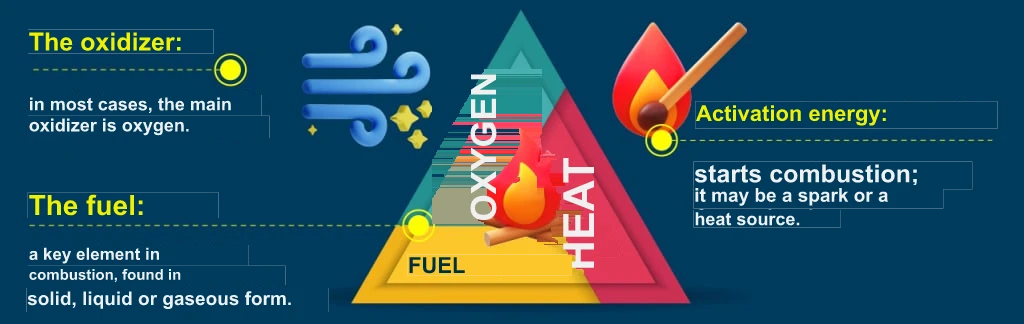
triangle of fire blog Jesus Sanchez training and consulting
To fight a fire, one or more elements of the fire triangle have to be stopped. The techniques vary depending on the type of fire but some general measures include:
- Remove fuel: If fuel can be removed from fire, the fire spread will stop. For example, if fuel is paper, fire can be put out with a dry chemical powder extinguisher or water and then remove paper to avoid re-igniting.
- Remove oxygen: If an oxygen supply is cut, the fire will be extinguished. That can be done by applying an extinguisher agent that covers the fire and cuts the oxygen supply. Carbon dioxide extinguishers are effective for this purpose.
- To reduce heat: Reducing the heat present can reduce a fire's intensity, using an extinguishing agent that absorbs heat, such as water.
Remember that firefighting can be dangerous and potentially fatal. If you do not feel safe fighting a fire, call the fire department and evacuate the affected area as soon as possible.
————————————————————————————————
Do you want to train your staff? We help you with our course Emergency Response Team
————————————————————————————————
Know our course 100% online Emergency Response Team