There is a training maxim: If it is not measured, it is useless. Without assessing training’s impact, we are throwing money away. Why? Because we cannot know whether employees learned anything or how much. Did they learn only the concepts, or can they apply them? If they cannot put them into practice, there is no improvement. If there is no improvement, the training failed and your money was wasted.
Thus, evaluations are an inherent part of industrial and professional training and every course should have at least two types of evaluations:
- Knowledge assessments: as the name suggests, these measure the conceptual knowledge participants acquired during the course.
- Satisfaction: an assessment in which participants “rate” instructor performance, content, course impact, and even the training venue.
Let's be clear: when we talk about assessments, we go back to our tormenting middle- and high-school days, when teachers overflowed with delight during exam season and students experienced every possible emotion depending on the subject's difficulty. Nowadays, whenever I mention an “exam” in a course, participants start experiencing spasms of anxiety as they relive those high-school traumas that trigonometry left us with years ago—myself included.
But let’s take this step by step.
First. You are not an elementary, secondary or higher education teacher. You are a professional instructor for the development and continuous improvement of predominantly adult employees. So let go even of the idea of celebrating “Teachers’ Day.”
Second. Now that we understand we are instructors/facilitators rather than teachers, you must understand that your job is to create memorable, exceptional, extraordinary, magnificent training strategies. Do not play “little school.”
Therefore, an elite instructor must evaluate their training correctly and in a timely manner.
How many types of evaluations are there?
4 large groups:
- From knowledge.
- Skills.
- Of skills.
- Attitude.
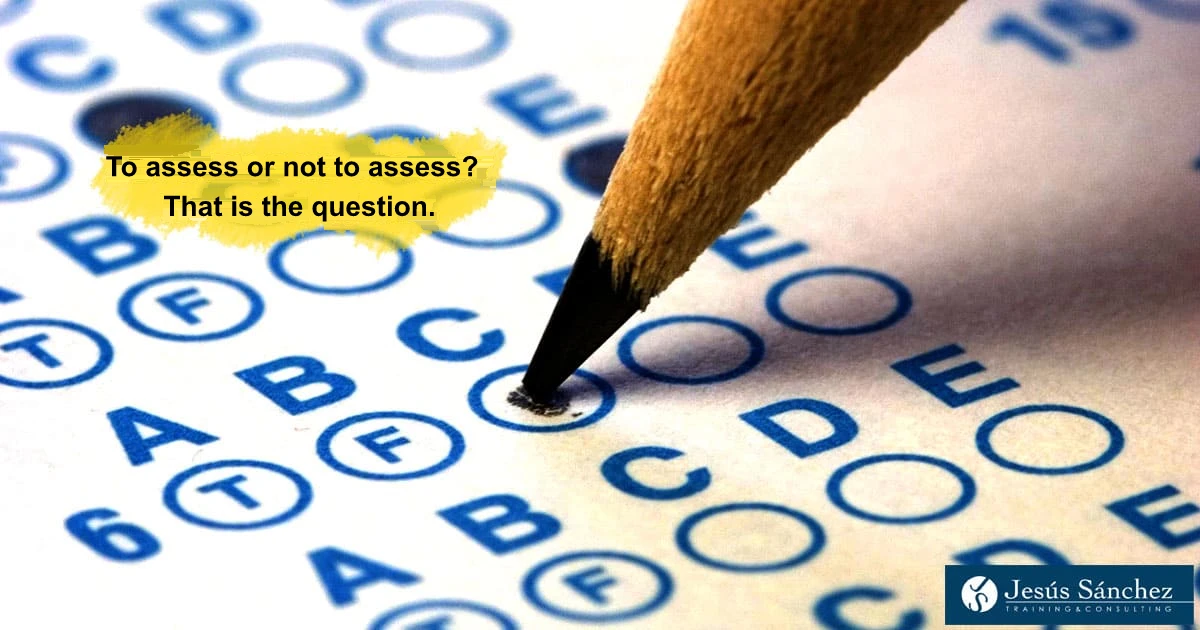
Knowledge assessments are the most common and widely used, with countless formats: classic short-answer and extended-response questions, or popular multiple-choice, matching and ranking formats.
Skills assessments relate to observational outputs and cases where behavior, rather than a tangible product, must be examined. They are limited to describing actions rather than judging them. They assess the acquisition of skills.
Then there are skills assessments, known for their checklists, which simply demonstrate whether someone is competent or not competent in a discipline.
Finally, attitude assessments use rating scales, generally scored from 1 to 5 (Very poor, poor, fair, good, very good).
So which assessments should we use for our courses? Dear colleague, you need to understand that assessments start with what you want to measure. Some work in certain situations but not in others. However, my strongest recommendation for staff training is to use assessments that provide the data we need while also being creative. Do not limit yourself to textbook assessments or those everyone uses. If you are truly committed to creating different training experiences, develop unique assessment ideas too—with balls, straws, costumes, games and activities.
In our “Train-the-Trainer” course, we review traditional assessments because that is the minimum you should know. However, we also present other assessments that have undoubtedly helped our new instructors spark knowledge in participants, because we firmly believe that, ultimately, learning should be FUN.
Rock´n roll, people!