What Are the Most Effective Instructional Techniques in Training? Although many theorists establish or share in-person, individual, group, opening, closing and icebreaker techniques, among others, we can identify three major techniques for adult training.
Combined with numerous strategies and tactics, these techniques create courses that engage attendees. The learning community develops more through participants’ contributions and collaboration than through the person at the front, who ultimately becomes a moderator.
However, we see every day in industry that instructor development is still far from being treated as essential. We take courses to train ISO auditors, supervisors and managers, and finally, if our underappreciated trainers are lucky, a Train the Trainer course. We find that trainers are really people who know their subject well, are often likable and sometimes know how to speak. For a very large number of facilitators, the main qualification is that they are “likable.”
Anyway, that is a subject for another post that we will address soon.
You already have your instructors—good or bad, professional or not, trained or not—delivering courses in bulk. They try to share good operating practices internally and teach external customers to sell or operate machinery, as my mother says, “as best they know how.” While you decide to provide formal Train the Trainer instruction and let us help, I want to share the 3 foundational training techniques.
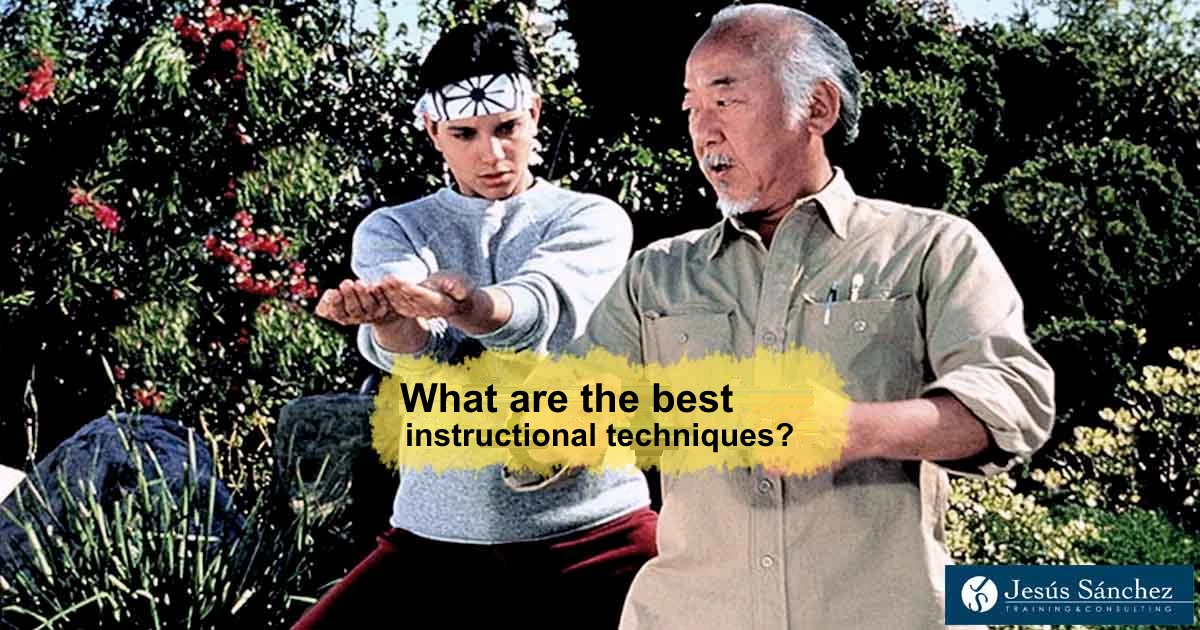
- Demonstration and practice: this is one of every good instructor's greatest tools. As its name suggests, the trainer must give a practical demonstration, following a structured process that is, above all, easy for attendees to understand and reproduce so that they can repeat the activity. Move from the general to the specific and from the simple to the complex. TAKE NOTE: when participants attempt the activity, the instructor must pay attention and provide appropriate, timely guidance to each attendee. We therefore strongly recommend working with groups of 10 to 15 people so that timely support is possible. With more trainees, a technique like this can make the instructor's life difficult.
- Effective presentation: the most widely used technique. We all use it and understand it, but not everyone knows how to do it properly. It is not about playing schoolteacher—you are an instructor or facilitator, not an academic lecturer, which are very different roles—or presenting your “class” as the pinnacle of wisdom. You should guide participants through a focused presentation, helping them learn at their own pace, in their own words and through their own experiences. Training then becomes a learning community rather than a long, tedious speech by someone “who knows it all.”
- Dialogue–discussion: finally, this wonderful technique is one I particularly enjoy. Its secret is to have participants hold a roundtable or debate, as needed, with guidance. The point is not to make them argue or confront one another to see who is stronger or right. The whole group should seek a solution to a problem, with each participant reflecting on and internalizing it to bring different perspectives to the table. This technique should create a learning community: “we all learn from one another.”
As I mentioned, these are the 3 main instructional techniques. We can find mutations, synergies, variations and many other changes depending largely on the theorist being studied. In our train-the-trainer course, we derive all the variations from these 3 approaches, as I have always believed the others stem from them. Who has the absolute truth? I do not know, but I have been directly responsible for training more than 1000 instructors in my career. I can proudly say some have become true “master trainers,” far surpassing the abilities of yours truly, your friend. Stay sharp!
Rock´n roll people!