The Importance of Kaizen
In Project Development
The continuous improvement is vital to maintaining relevance and efficiency. One of the most effective approaches to achieve this improvement is the Kaizen method. That article explores the importance of Kaizen in project development and how it can transform how initiatives are managed and implemented.
What is the Kaizen method and what is it used for?
Kaizen is a management philosophy focused on continuous improvement through small, incremental changes. It comes from the Japanese words “Kai” (change) and “Zen” (good), translated as “continuous improvement.” It is widely used across industries to increase efficiency, reduce waste and improve quality.
Where Does the Concept of Kaizen Come From?
The Kaizen concept has its roots in Japan, specifically in reconstruction after World War II. Masaaki Imai popularized it in his 1986 book “Kaizen: The Key to Japan's Competitive Success.” Since then, it has been adopted globally as a fundamental tool for quality management and continuous improvement.
What results do you get from applying Kaizen?
applying the Kaizen method can lead to a number of significant benefits:
- Increased productivity: To improve processes reduces the time and resources necessary to complete tasks.
- Cost reduction: Identifying and eliminating waste saves money.
- Improving quality: The constant small changes improve product or service quality.
- Increased customer satisfaction: better quality products and services increase customer satisfaction.
- Improving the work environment: Involving employees in the improvement process creates a more positive and collaborative work environment.
What are the 5S of Kaizen?
The 5S are a set of Japanese practices that are an integral part of Kaizen. These are:
- Seiri (Classification): To divide what's necessary from what's unnecessary.
- Seiton (Order): Organize what's necessary to be easy to find and use.
- Seiso (Cleanup): Keep work space clear and tidy.
- Seiketsu (Standardisation): To standardize best organizational and cleaning practices.
- Shitsuke (Discipline): To promote autodiscipline and the habit of following established procedures.
The 5 steps of the Kaizen method
Implementing Kaizen in a project follows five fundamental steps:
- To identify the area of improvement: To detect processes or areas that require improvement.
- Analyzing the process: Understand the current process and its deficiencies.
- To develop solutions: Propose and plan improvements.
- Implement changes: Implement the solutions designed.
- Review and Adjust: Evaluate the results and make adjustments if necessary.
5 Advantages of Kaizen method
The benefits of applying the Kaizen method are numerous:
- Flexibility: Adaptable to any industry or work area.
- Employee focus: Involves all levels of the organization.
- Sustainable results: Promotes continuous, sustainable improvements.
- Reduction of waste: Identifies and removes waste in processes.
- Continuous improvement: It promotes a culture of constant assessment and improvement.
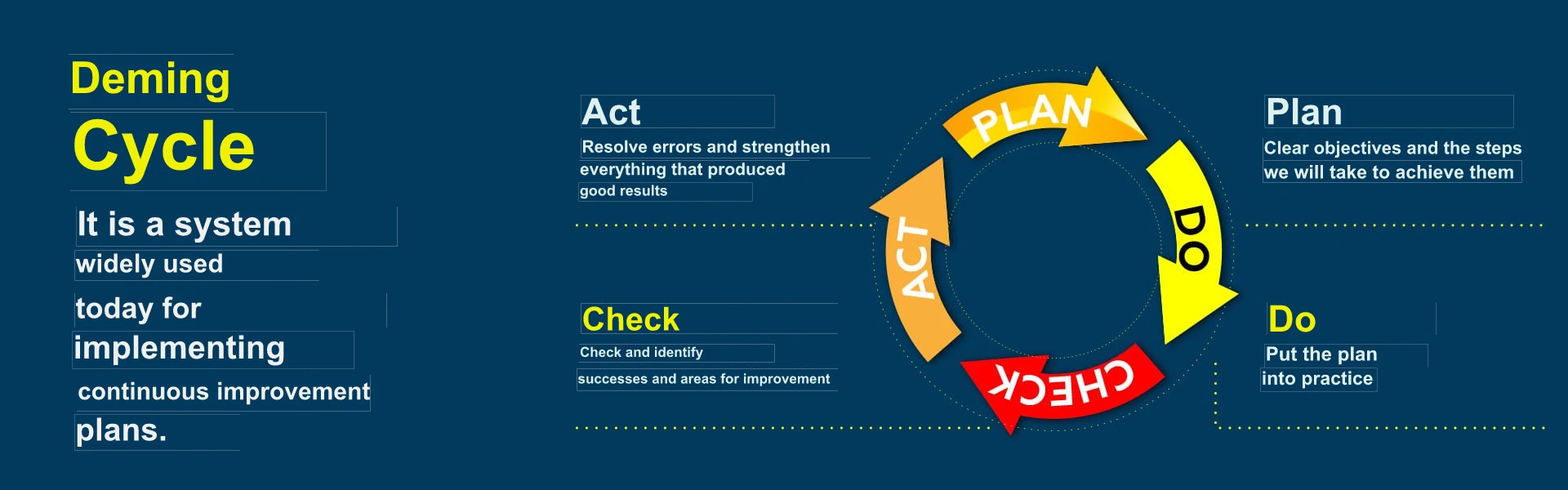
The PDCA cycle or Deming circle based on Kaizen
The PDCA cycle (Plan-Do-Check-Act), also known as the Deming cycle, is a key tool in implementing Kaizen. This cycle consists of four stages:
- Plan (Plan): To identify and analyse the problem and then plan necessary improvements.
- Do (Do): Implement improvements in a small test or at a limited scale.
- Check (Check): To evaluate the test results to check if the improvements worked.
- Act (Act): If the improvements succeed, implement them on a larger scale and standardize them; if not, return to planning and make adjustments.
Conclusion
Kaizen is a powerful tool for organizations seeking to improve processes and results. Its emphasis on continuous improvement, employee involvement and waste reduction makes it indispensable in project development. Ongoing training in Kaizen and its techniques keeps teams ready to identify and seize improvement opportunities. Start your journey toward excellence with Kaizen today!