Process FMEA (AMEF): Key Steps to Reduce Risks and Operational Errors
In increasingly competitive business environments, operational errors, recurring failures and unidentified risks can generate high costs and directly affect quality. Process FMEA (AMEF) is a key tool for anticipating problems before they occur and strengthening decision-making.
Correctly applying process FMEA (AMEF) provides a structured analysis of where processes may fail, the consequences and the preventive actions needed to reduce risks and improve operational performance.
What is process FMEA (AMEF), and what is it used for?
Process FMEA (AMEF: Process Failure Mode and Effects Analysis) is a preventive methodology for identifying, evaluating and prioritizing potential risks within a production or administrative process.
Its main aim is to prevent failures rather than react to them. Systematic analysis helps organizations identify critical points, minimize operational errors and improve process reliability.

The difference between process FMEA (AMEF) and other FMEA (AMEF) types
Although the principle is the same, process FMEA (AMEF) focuses on how a process is performed, while other types, such as design FMEA (AMEF), analyze risks during product conception. This distinction is key to applying the tool at the right point in the operating cycle.
Why is applying process FMEA (AMEF) important for a company?
Implementing process FMEA (AMEF) brings clear, measurable benefits. The most significant include:
- Fewer errors and less rework
- Preventing failures before they affect customers
- Improved operational efficiency
- Data-based risk prioritization
- Support for quality management systems
Consequences of failing to identify process risks
When risks are not analyzed proactively, organizations often face recurring failures, quality deviations, hidden costs and lost customer and employee trust. In many cases, properly applied FMEA (AMEF) could have prevented these problems.
Key Steps for Conducting an Effective Process FMEA (AMEF)
For the analysis to be useful, follow a clear, structured methodology.
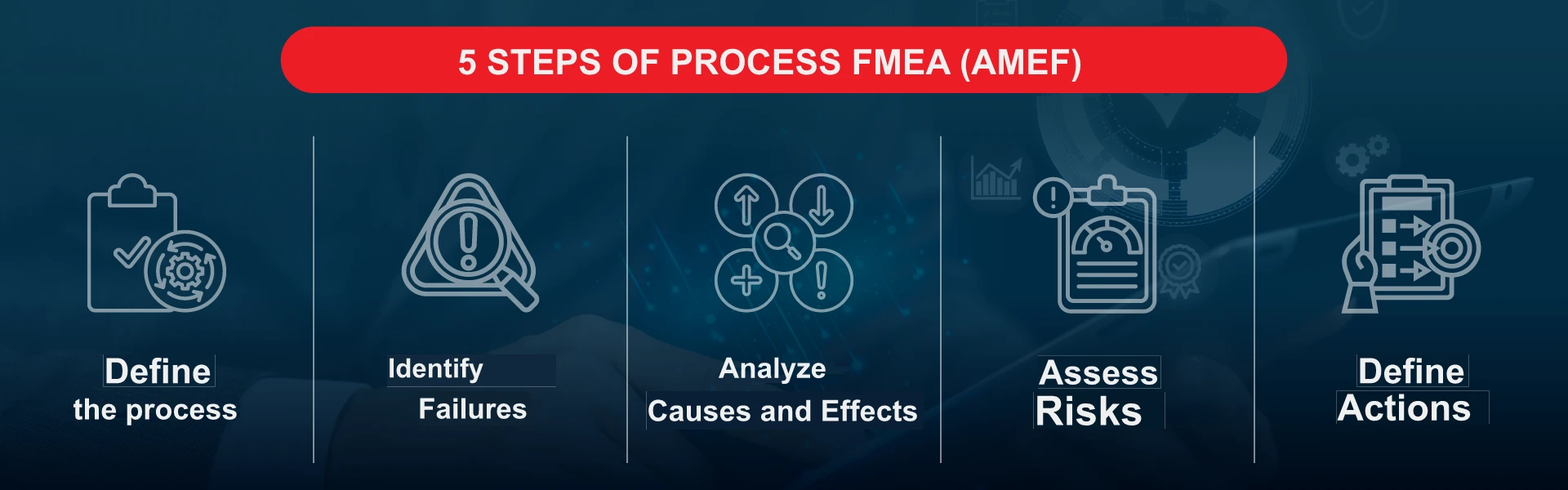
Step 1 – Define the process and its scope
First, clearly define the process to analyze, identifying its stages, responsible people, inputs and outputs. A poorly defined scope can lead to incomplete or unhelpful analysis.
Step 2 – Identify potential failure modes
Identify how each part of the process could fail. Base this on real data, operational experience and team feedback.
Step 3 – Analyze each failure's causes and effects
Analyze each failure mode by considering:
- Causes: why it could occur
- Effects: its impact on the process, customer or business
This analysis reveals the true severity of each risk.
Step 4 – Evaluate risks (Severity, Occurrence and Detection)
Assign values to each criterion to prioritize the most critical risks, focusing resources on genuine threats to operations.
Step 5 – Define actions to reduce risks
Finally, establish preventive or improvement actions to reduce severity or occurrence, or improve failure detection. FMEA (AMEF) does not end with analysis; its value lies in action.
Common mistakes when applying process FMEA (AMEF)
Although powerful, this tool's effectiveness depends on how it is used.
Focusing only on compliance, not prevention
A common mistake is using FMEA (AMEF) only as a documentation requirement, without seeking real improvement. This reduces its impact and strategic value.
Not following up on actions
Defining actions without follow-up turns FMEA (AMEF) into a theoretical exercise. Periodic reviews and progress monitoring are essential.
When should you update or review process FMEA (AMEF)?
FMEA (AMEF) is not a static document. Review it when significant operational changes occur.
Changes in processes, equipment or results
Situations requiring an update include:
- Changes in working methods
- New equipment or technologies
- Increased failures or nonconformities
- Results outside established targets
Process FMEA (AMEF) as a continuous improvement tool
Beyond prevention, process FMEA (AMEF) promotes analysis, learning and continuous improvement. Properly integrated, it becomes essential support for quality management systems and strategic decision-making.
For those seeking a more practical, applied understanding of process FMEA (AMEF), JS Training & Consulting also offers its specialized FMEA course (AMEF), which explores the methodology, evaluation criteria and real applications in different organizational settings. This training helps standardize risk analysis and strengthen continuous improvement within teams.
Conclusion
Process FMEA (AMEF) is among the most effective tools for reducing risks and operational errors when applied systematically and preventively. Its true value lies not only in analysis but also in actions that improve process reliability, quality and efficiency.
Investing time in developing FMEA (AMEF) correctly means investing in stronger processes and better-informed decisions.