
New ISO 9001: 2026 review
Leadership, risks and continuous improvement at the centre of change
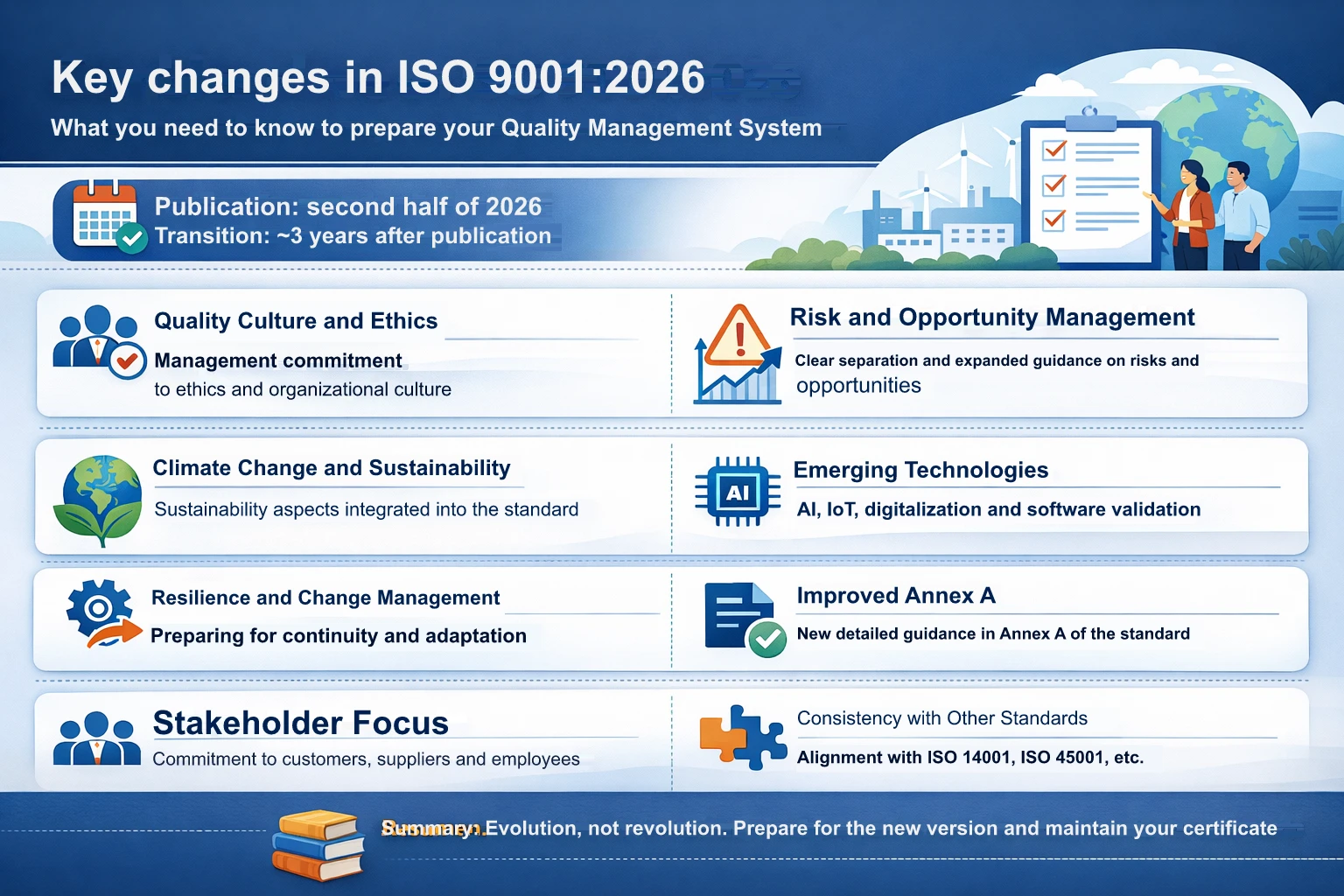
The next update of the standard ISO 9001:2026 has generated doubts, anxiety and many organizational questions. Yet the reality is much clearer and calmer than it seems: The changes aren't radical, but evolutionary, focusing mainly on strengthening leadership, quality culture, risk management and continuous improvement.
If your company already has a mature Quality Management System (SGC), this transition will be Natural and manageable. Below, we explain clearly and practically the most relevant changes in the standard's current draft.
Climate change actions
One of the most visible adjustments is the formal integration of climate change actions within the standard's content. This requirement had already been incorporated into the clauses in 2024 4.1 (Organization context) and 4.2 (interested parties), and is now reinforced as a structural part of ISO 9001.
Practical recommendation. Assess how climate change affects your processes, suppliers, and customers, and document concrete actions within your Quality Management System (SGC).
Quality culture and ethical conduct
That's definitely... the most important change of the new review. The standard emphasizes that quality depends not only on processes, but also on the conduct, values and organizational ethics.
The main points are:
- The leadership must actively promote a culture of quality as part of its commitment to the SGC (Clause 5.1).
- The quality policy have to reflect these values clearly.
- The quality culture forms part of environment for operation of processes (Clause 7.1.4).
- The strengthening of awareness-raising (Clause 7.3), focused on preventing corruption, conflicts of interest and unethical conduct that could affect QMS results.
- Incorporates the ethical use of emerging technologies, such as Artificial Intelligence, ensuring that its implementation does not compromise the organization’s values (Clause 7.1.2).
- The communication with customers must be clear, ethical, and aligned with legal and regulatory requirements (Clause 8.2.1).
Practical recommendation. Check your quality policy and make sure that it reflects real ethical values, and not just formal statements.
Risk and opportunity management
The new version more precisely clarifies how to manage risks and opportunities, aligning with the approach of ISO 31000:
- To identify risks.
- Analyze them.
- To evaluate them.
Special attention is paid to risks that may affect Business continuityand opportunities are now more clearly addressed in an independent requirement.
Practical recommendation. Integrate business continuity into your risk matrix and define realistic action plans.
Planning and management of changes (Clause 6.3)
The standard goes into greater depth on the need for manage QMS changes in a controlled manner, ensuring that:
- The changes are monitored to evaluate their effectiveness.
- They communicate appropriately within the organization.
- Results are reviewed so as not to affect the ability to meet objectives.
Practical recommendation. Document how you manage changes and measure their impact on the system’s results.
Remote and hybrid work
A clarifying note is incorporated, establishing that the infrastructure must cover the different work arrangements: on-site, remote or hybrid (Clause 7.1.3).
Practical recommendation. Ensure that your information and technological resources support all models of work.
Business continuity
This topic is reinforced within risk management (Clause 6.1), identifying:
- Disruptive factors that could affect operations.
- Response actions.
- clear communication to the client in the event of contingencies (Section 8.2.1).
Practical recommendation. Define critical scenarios and response plans before interruptions occur.
Using digital means
The rule formally recognizes the use of Digital Media for:
- Communication with customers (email, platforms, social networks, websites).
- Measurement customer satisfaction (Clause 9.1.2).
Practical recommendation. Verify that your digital channels are controlled, documented and aligned with the QMS.
Strengthened continuous improvement
The clause 10.3 disappears and is incorporated into clause 10.1 - continuous improvementstrengthening that improvement should be based on:
- Data.
- Monitoring and measurement results.
- Analysis and evaluation of SGC performance.
Practical recommendation. Use real indicators and reliable data to boost continuous improvement.
A simple and strategic transition
as you can see, the review of ISO 9001:2026 does not imply drastic changes, but a logical evolution toward more ethical, resilient systems aligned with today’s reality.
The rule is expected to be published at September 2026. In addition, during this same year, the following will also be updated ISO 14001, ISO 45001 and ISO 19011, and in 2027 a new version is expected of IATF 16949 for the automotive industry.
At JST&C We'll be ready to support you with:
- Standard update
- Interpretation and implementation
- Internal Auditor
- Lead Auditor
Contact us and get ready with time to strengthen your Management System and turn change into a competitive advantage.