
Become a Green Belt | Start Today!
What it is, what it does, benefits and how to get certification
A Green Belt converts operational problems into measurable improvement projects.
A Lean Six Sigma Green Belt He's a trained professional to analyse and improve processes using Lean tools, Six Sigma, statistics and structured problem solving methodology.
Its objective is to reduce waste, errors, variation, time and costs, while improving productivity, quality, and customer satisfaction.
It is not just about finding errors. A Green Belt seeks to understand why a problem occurs, what data demonstrates it, how to solve it and how to prevent it from recurring.
Why's Lean Six Sigma still important?
Companies constantly seek to improve their processes: produce more, make fewer errors, reduce costs, and offer a better customer experience.
That is where Lean Six Sigma becomes valuable.
Lean focuses mainly on eliminating waste and improving flow while Six Sigma aims to reduce variation and defect through data and statistical analysis.
| Lean | Six Sigma |
|---|---|
| Eliminates waste | Reduces variation |
| Upgrading the flow | Reduce defects |
| It reduces times | Analyze data |
| Eliminate activities that add no value | Identifies root causes |
Lean Six Sigma combines both approaches to improve process performance.
Lean Six Sigma Green Belt
A Green Belt can participate or lead improvement projects within its area of work.
Their responsibilities may include:
- To identify challenges and opportunities.
- To collect and analyse data.
- Find root causes.
- To design and test solutions.
- To measure results.
- Implement controls.
- To present results to leaders and work teams.
For instance, a Green Belt project could look reduce rejected products from 5% to 2%reduce customer response time or reduce the rework of an administrative process.
The main point is that the project should have a defined problem, measurable indicators and results.
DMAIC: The methodology every Green Belt should know
One of the main methods of Six Sigma is DMAICused to improve existing processes with performance challenges.
| Stage | What are you looking for? |
|---|---|
| Define | To clearly define the problem |
| Measure | Measuring current performance |
| Analyze | Finding root causes |
| Improve | Design and implement improvements |
| Control | Keep results |
1. Define - Define
To clearly identify the problem, its impact and the expected result. Avoid starting with a solution without first understanding the situation.
2. Measure — Measure
To set a base line with data: how often it occurs, when, where, what type of problem it is, and what it costs.
What isn't measured can hardly be improved.
3. Analyze - Analyze
To identify root causes of the problem using tools such as Pareto, 5 Why, Ishikawa, histograms and statistical analysis.
4. Improve — Improve
To design and implement solutions, performing pilot tests or experiments to to prove that they lead to an actual improvement.
5. Control - Control
Maintain results by indicators, procedures, audits, and follow-up mechanisms, ensuring that improvement is sustainable.
Tools used by a Green Belt
A Green Belt does not need to use every tool in every project. What matters is knowing What to use, when and how to interpret your results.
| Area | Some tools |
|---|---|
| Processes | SIPOC, process maps, VSM |
| root cause | Pareto, 5 Why, Ishikawa |
| Data | Histograms, control charts |
| Statistics | Capability, Hypotheses, Regression |
| Enhancement | 5S, Poka-Yoke, DOE |
| Control | Control plan, indicators |
Lean Six Sigma generates results
There are documented studies and cases with concrete results.
For example, a DMAIC project applied to an olive production and packaging process reported US$228,000 in Estimated Annual Savings, in addition to a reduction in 51.02% at standard deviation and 99.97% in defective parts per million.
Another project applied to the manufacture of automotive rubber moldings reduced the rejection rate from 5.5% to 3.08% and daily Rejections of 153 to 68 pieces.
These cases show something important: an improvement project can generate financial and operational results at the same time.
Nevertheless, these percentages are for specific projects and do not represent an assurance of performance for any company.
Lean Six Sigma + Artificial Intelligence: A New Opportunity
Artificial intelligence is opening up new possibilities for continuous improvement professionals.
Research is currently exploring how to combine Six Sigma with machine learning, deep learning, data analysis and experiment design to improve industrial processes.
AI (IA) can help to:
- Analyze large volumes of information.
- Detect patterns and anomalies.
- Check client comments.
- Automate reports.
- To generate research hypotheses.
- To identify potential relationships between variables.
But there's a fundamental difference:
AI (IA) can find patterns; the Green Belt must verify whether those patterns actually represent a cause of the problem.
That's why technology can complement DMAIC but does not replace critical thinking, knowledge about the process and validation of data.
Do you need to know statistics to be Green Belt?
Yeah, but you don't have to be a mathematician.
The aim is to use statistics to make better decisions.
The concepts that a Green Belt should normally master are:
- Mean and median.
- Standard deviation.
- Distributions.
- Variation.
- Process capability.
- Hypothesis testing.
- Correlation.
- Regression.
- Statistical control.
The key isn't to memorize formulas but to know What tool to use and how to interpret its results.
What industries can a Green Belt work with?
Lean Six Sigma isn't unique to factories.
It can be applied practically to any organization with measurable processes.
| Area | Project example |
|---|---|
| Manufacturing | To reduce defects |
| Logistics | Reduce delivery times |
| Human resources | Reduce recruitment time |
| Finance | To reduce billing errors |
| Customer service | Reduction of response time |
| Technology | To reduce incidents |
| Health | Reduce waiting times |
| Supply Chain | Optimizing inventories |
| Sales | To reduce conversion time |
That's why studying Green Belt can be useful for professionals at quality, production, engineering, operations, logistics, Supply Chain, continuous improvement, finance, human resources and customer service.
How much can a Six Sigma professional earn?
Wage depends on factors such as experience, industry, jobs, countries and responsibilities.
For reference, an ASQ salary survey reported that people with a Six Sigma Belt certification earned, on average, US$16,000 more per year than those who did not have Six Sigma certification. The figure comes from ASQ’s 2021 salary survey.
But there is something even more important than having the certificate:
Prove results.
It does not carry the same weight to say:
I have a Green Belt certification.
To say:
"I led a project that reduced rework 35% and generated $800,000 MXN of annual saving."
The second statement shows occupational impact.
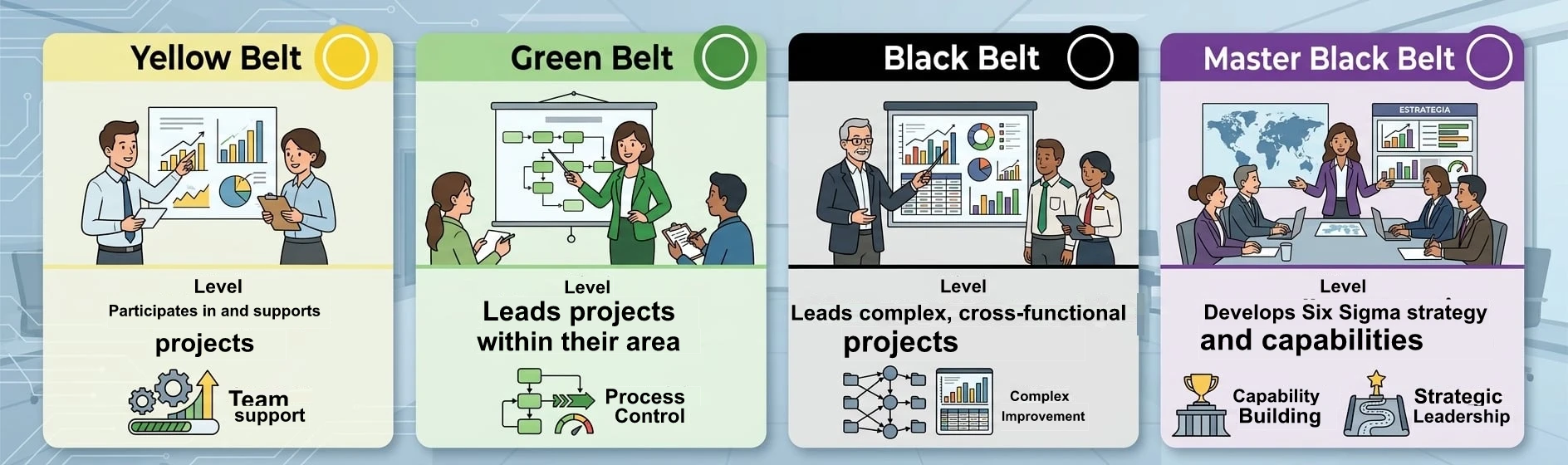
What's the difference between Yellow Belt, Green Belt and Black Belt?
The levels may vary with the certification body but they can generally be understood as follows:
| Level | Main function |
|---|---|
| 🟡 Yellow Belt | Participates and supports projects |
| 🟢 Green Belt | Leads projects within their area |
| ⚫ Black Belt | Leads complex, cross-functional projects |
| 🏆 Master Black Belt | Develop Six Sigma strategy and capabilities |
The Green Belt usually represents an intermediate level: it has sufficient knowledge to leading improvement projectsbut normally she keeps performing responsibilities within her area.
Conclusion
Lean Six Sigma Green Belt is far more than a certification.
It's a methodology to turn business problems into measurable improvement projects, using data to reduce waste, variation, errors and costs.
Documented cases show that they can generate significant improvements in quality, productivity and financial performance while artificial intelligence and advanced data analysis are creating new opportunities for continuous improvement professionals.
The true value of a Green Belt isn't just about knowing DMAIC.
It lies in being able to answer:
What problem do we have? → What do the data say? → What is the cause? → Which solution works? → How do we sustain the improvement?
Do you want to develop your skills at Lean Six Sigma?
At JS Training & Consulting you can develop the skills necessary to apply Lean Six Sigma to real continuous improvement projects.
Our program Lean Six Sigma Green Belt addresses:
DMAIC · Lean · Statistics · Root Cause · Process Improvement · Waste Reduction · Process Control
📩 Request information about the Green Belt program.