
Over the last 10 days, after quite some time, I found myself packing my bags and traveling for several days again. The last months of the year are an extremely busy season for us, when every pair of hands at JST&C moves at a frantic pace. For your friend and humble writer, that is wonderful. Boring, slooooow days at the office—like an office worker in their natural habitat—have never been my thing.
I set off on one of those multi-destination business trips: CDMX – Campeche – CDMX – Puebla – Qro – Gto – Qro. I had not visited Campeche for a couple of years; running along its waterfront at sunrise is an incredible sight. For reasons beyond our logistics, I arrived at 7 am after leaving home 8 hours earlier. As you can imagine, getting off the plane, all I wanted was to reach my room, sleep a couple of hours, shower and have breakfast.
I had forgotten how brusque and hostile many people working directly in tourism in this city can be. You might think customer service is everyone's creed, but nein! From the taxi driver who answers curtly and harshly to arriving at the hotel exhausted and being greeted at reception with: “Sorry, young man, check-in is not until 3 pm.” “3 pm???” I said. “It is 7.20 in the morning. Do you not have a room available, or something that could help me?” “Oh dear, no. We are full, and that is the policy.”
Well, come on, I understand the policy, but... isn’t there another solution, another way, another alternative? I thought that as soon as a room became vacant, we could have it cleaned and that would be that. People were checking out right in front of me. But no, dear reader: the only thing I was politely invited to do was have breakfast at the buffet. To give you an idea, I stayed at City Express in Campeche, and its buffet was just eggs (of course), fruit, coffee and a little more. How long does breakfast take you? 40 minutes at most? So there I was, your humble servant, wandering around Campeche from 8 am to 3 pm, and yes... completely worn out.
I find it incredible: the sale is already made, the reservation exists, and all that remains is payment, yet a lack of attention to customer needs and understanding of basic customer service and negotiation can ruin it. Someone with a shorter temper would grab their bags and leave for another hotel. I think this is the problem with large hotel chains. Of course, the experience at City Express in Campeche differs from the one in Polanco, CDMX: the market is different, training varies, and the experience may improve or not. But shouldn’t there be a standard? Why are these procedures followed to the letter in some locations and not others? The larger the organization and the farther it is from the capital, the more its processes become diluted—the opposite of what should happen.
I spent 4 days there and had a similar experience at a traditional restaurant someone recommended. The food was simply de-li-cious. I ordered a seafood-stuffed fillet, battered into a ball and covered in chipotle cheese sauce. Extraordinary. To welcome you, they serve ground pumpkin seeds with spices. The busboy cheerfully claimed they were good for omega 3, cholesterol, your mood, even as a substitute for Viagra, along with whatever else occurred to him as he tried to be kind and make me feel welcome. Dear reader, when the waiter arrived, the charm vanished in an instant: scowling and surly, he did not even say good afternoon or look at me. “What will you have?” he asked, looking elsewhere, without any intention of making a good impression on the customer. A sad situation.
And do you know something? It is a cultural issue within organizations: sales, customer service and negotiation go hand in hand; one cannot exist without the others. But staff do not understand that we all represent the same corporation, that “We are all the company,” and that every experience and moment of truth a customer has can determine whether they buy, whether they return, or, worse still, whether they recommend you or bad-mouth you to the 4,000 contacts in their WhatsApp and Facebook groups. Watch out! It is not as easy as it seems. There are many complications you should consider. Otherwise, salespeople rack their brains to close deals, constantly negotiating with difficult customers, “dog” customers, loyal customers and advocates, only for execution or operations to arrive and everything to go to hell because of crude, rigid or nonexistent customer service processes.
Understand that this is not all about operations. It begins with purchasing, suppliers and business partners. This customer-centered philosophy should permeate the organization from management downward. But what can I tell you? To speak to your director, you have to request an appointment, and if you are lucky, you get one a month later. There is your answer.
Still, I do not make a drama of it. I am used to these situations and let them slide. But it strikes me because staying in such a competitive market is hard enough without someone who is unhappy with their “miserable” life, in their “miserable” home, with their “miserable” family—and, of course, shows it in their “miserable” work.
I went to that beautiful city to deliver our high-quality customer service seminar for a financial company experiencing exponential growth. They sought our support to prepare for another major leap forward.
After those days away, I returned to Puebla, a city I hold dear because of its many friends, streets, art and people… or, above all, because its mole and chiles en nogada are an extrasensory experience.
In Puebla, we usually stay at Hotel Lastra, a longstanding city hotel: one of those businesses surviving against the odds while competing with major hotel chains. Here lies the huuuuge difference. Staff pay attention to details and always strive for a superb stay, so the customer leaves saying, “Woooooow!”
As soon as you step inside, you receive a smile and an enthusiastic “Welcome!” But let me tell you what has truly surprised me. During the previous course, I requested a small pot of coffee to keep my throat moist while training, and at lunch I asked for a sugar-free Coke. This time, every day when I arrive in the room to begin the course, the pot of coffee is already waiting. At lunch, they always ask whether I would like my sugar-free Coke.
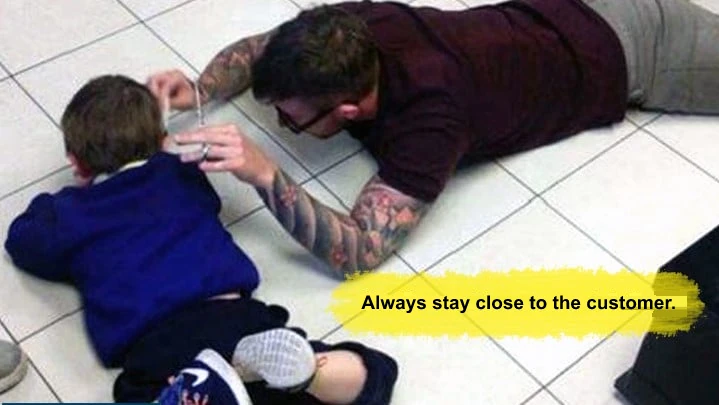
Dear reader, that is high-quality customer service. It is not just smiling and being empathetic, or keeping the room or meeting space clean and tidy. This methodology goes further, understanding that you work with and for human beings: people like you and me who also get tired and have bad days. With the right focus, sensitivity and, above all, attitude to recognize that a small pot of coffee can make a difference, you can change someone's day.
I find it surprising that companies smaller than the major brands pay more attention to these processes. In this case, hotel chains already make so much money and are so well established that these protocols sadly tend to disappear and become diluted among the thousands of employees working there. And this is not limited to hotels: think of cinemas, department stores and restaurants. Wherever you look, major brands often lose sight—although there are clear exceptions—of what your friend and humble writer, here at this computer, considers every company's most important asset: the customer.
Until companies understand that every effort should begin and end with giving customers a wonderful experience, we will keep encountering people who act as though even taking payment is a favor. Ultimately, that affects the company’s pocket too, you know.
Stay sharp!
Rock´n roll people!