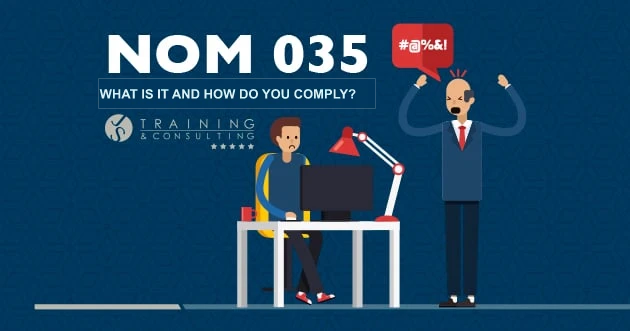
A couple of years ago, Mexico’s government issued the now-famous Official Mexican Standard 035 on identifying, analyzing and preventing psychosocial workplace risks. Since then, every organization has been required to comply.
This has caused many conflicts in organizations that have not truly understood what it involves, much less implemented it. The pandemic we are immersed in made it even more difficult to determine how to comply with this standard.
But before we begin implementation, the first thing we need to understand is what psychosocial risk factors are. What does this mean?
Let us understand this: psychosocial risk factors can cause anxiety disorders, sleep-cycle disorders, severe stress disorders and adjustment disorders. These arise from the nature and duties of jobs, the type of working schedule and/or workers' exposure to severe traumatic events or workplace violence as a result of their work.
These factors also include dangerous and unsafe workplace conditions, excessive workloads, lack of control over work, working hours exceeding those established by the Federal Labor Law, rotating shifts that include night work, night shifts without recovery and rest periods, and anything that interferes with work–family balance, along with negative leadership and relationships in the workplace
Having understood this, we must recognize the importance of implementing and embracing NOM 035 within our organization. To implement it, we as employer organizations must consider the following points:
- To put in place a policy to prevent psychosocial risks within the organisation.
- That policy should reflect commitments to prevent psychosocial risks, prevent labour violence and promote an enabling organizational environment.
- It must identify those responsible and the resources available for implementing policies at every level of the organization.
- It should consider the assignment of responsibilities to both people and work teams, and they should be trained for policy implementation.
- To identify and analyse the psychosocial risk factors regardless of the size of the organisation.
The risk assessment should cover:
- The conditions in the work environment.
- The workload.
- The lack of control about work.
- Working hours and shift rotation that exceed the provisions of the Federal Labor Law.
- Interference in the work-family relationship.
- Negative leadership in negative labor relations.
- The violence at work includes: psychological harassment, harassment and ill-treatment.
In the case of, in the case of organizations with more than 50 workers, the following must also be considered:
- The workers' sense of belonging.
Training for the conduct of the tasks entrusted.
- The definition of responsibilities for workers.
- Proactive participation and communication among the employer, their representatives, and workers.
- The proper distribution of workloads with regular working hours.
- Performance appraisal and recognition.
For this identification and analysis, NOM 035 provides a questionnaire in Reference Guide II that we can use.
- Take measures to prevent and control psychosocial risk factors.
The actions and programmes for the prevention of psychosocial risk factors should consider the following to prevent violence at work and to promote an enabling organizational environment:
- Actions based on leadership and work relationships.
- Measures about workload.
- Actions concerning control over work.
- Measures with regard to social support.
- Actions to balance the work–family relationship.
- Measures to generate mechanisms for recognition of work.
- Measures to prevent violence at work
- Measures concerning communication and information provided to workers.
- Actions concerning worker training and skills development.
- Identify workers who experienced severe traumatic events or work-related traumatic events.
For this identification, NOM 035 provides a questionnaire in Reference Guide I that we can use to identify these workers.
- Conduct medical examinations and psychological assessments for workers exposed to workplace violence and/or psychosocial risk factors.
This will apply when signs or symptoms indicate a health impairment and the findings from identifying and analyzing psychosocial risk factors suggest it, and/or when complaints of workplace violence have been submitted through the workplace's complaint or reporting mechanisms.
- To disseminate and provide information to workers.
The information to be provided to them should cover:
- The policy of preventing psychosocial risks.
- Measures adopted to combat practices that are contrary to the enabling organizational environment and acts of labour violence.
- Measures and actions to prevent psychosocial risk factors.
- Mechanisms for submitting complaints or reports.
- The results of the identification and analysis of psychosocial risk factors.
- Potential health effects from exposure to psychosocial risk factors.
- Keep records of the results of psychosocial risk identification and analysis, the control measures adopted, and the names of workers who underwent clinical examinations or assessments.
In summary, implementing NOM 035 should help organizations create a healthy, favorable environment free from intimidation, violence, harassment and fatigue, fostering sound organizational harmony.
This will surely increase organizational productivity and performance. Embrace it: it will greatly benefit your organization.
Do you want to implement NOM 035? At JST&C, we are here to help!