
ISO 14001: 2026: The change your company cannot ignore
The Environment is one of the most important concerns today in the world
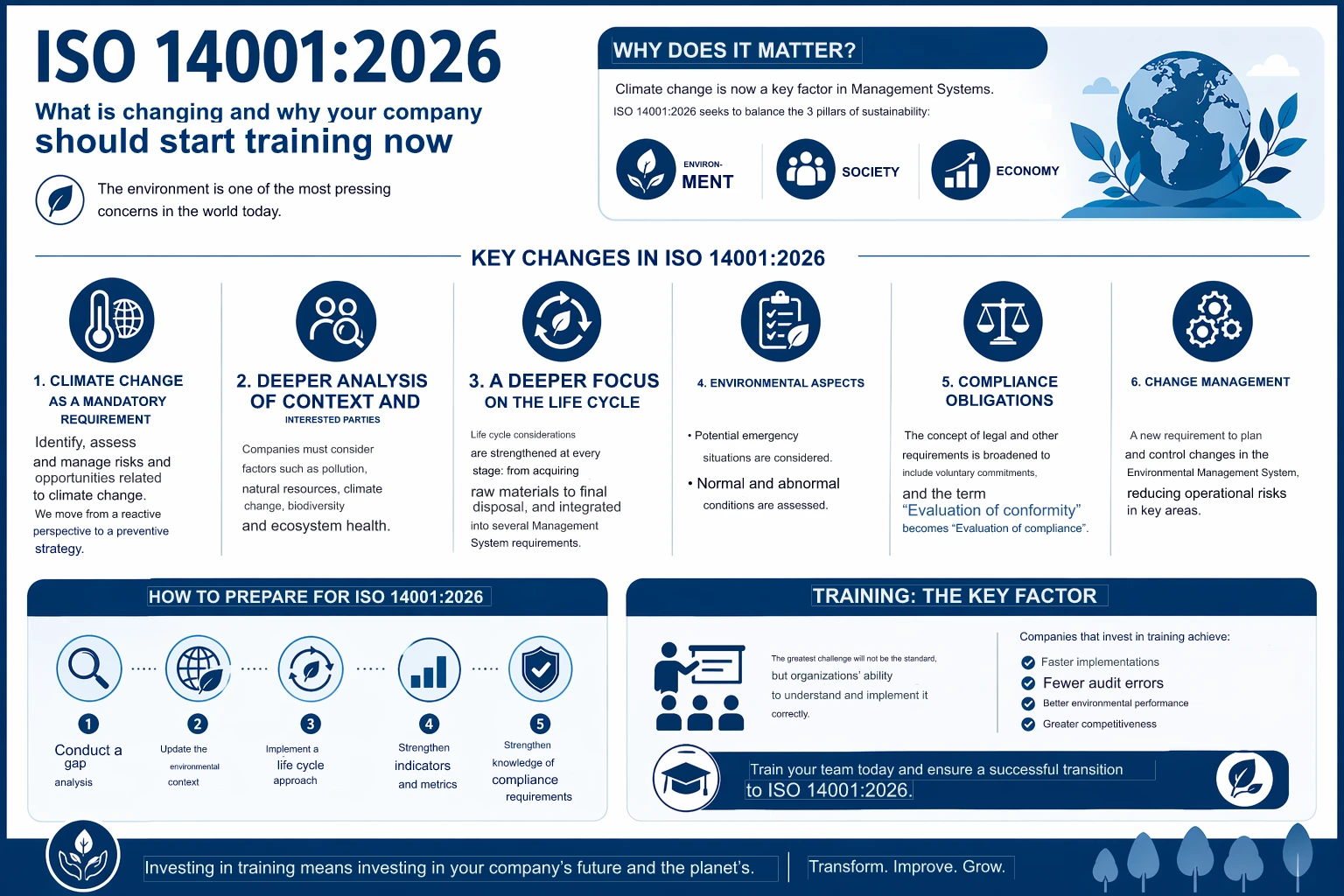
Climate change has become one of the main factors analyzed within management systems of every kind worldwide. Hence the need to revise ISO 14001, primarily to achieve the right balance between the 3 pillars of sustainability: the environment, society, and the economy.
That is why we have to understand that undermining the environment can have economic, social and corporate consequences.
Depending on this, ISO 14001: 2026 aims at:
- To protect the environment by preventing or mitigating adverse environmental impacts
- To mitigate the potentially adverse effects of environmental conditions on the organisation;
- Support to the organization in meeting compliance requirements and obligations
- control or influence over how the organization designs, manufactures, distributes, consumes and ultimately disposes of products or services, using a life cycle perspective that can and does prevent adverse environmental impacts from unintentionally shifting to another point in the life cycle;
- Obtain financial and operational benefits from implementing environmentally responsible alternatives that strengthen the organization's market position;

Main ISO changes 14001: 2026
- Climate change as a required requirement
This change was already made in the 2024 amendment and is now included in the standard itself. It focuses on identifying, assessing and managing climate-related risks and opportunities within the environmental management system. This means moving from a reactive perspective to a preventive strategy.
- Deeper analysis of the environmental context and interested parties.
The analysis will require companies to consider factors such as:
- Contamination levels
- Availability of natural resources
- Climate change
- Biodiversity
- Health of ecosystems
- A deeper approach to a life cycle
Although the life cycle approach has always existed within the standard and must be considered in each of its different stages as are:
- Acquisition of raw materials
- Design
- Production
- Transport / delivery,
- Use,
- End-of-life treatment
- Final disposal.
This update specifies where it must be considered across management system requirements, for example:
- The scope of the Environmental Management System (SGA) must consider its authority and ability to exercise control and influence throughout the life cycle of its activities, products, and services.
- Include environmental considerations at every stage of the life cycle.
- In product design and development while setting up its operational controls.
- Environmental aspects
The important change is that it now states that the analysis of environmental aspects must consider:
- The identification of emergency situations potential Instead of reasonably foreseeable.
- The conditions normal and abnormal
- Compliance obligations
A new terminology was put in place to identify legal and other requirements and to include requirements concerning:
- Mandatory requirements, such as:
- The applicable laws and regulations
- Or voluntary commitments, such as:
- The rules of organisations or industry.
- Contract relations
- Codes of good practice
- Agreements with community groups or non-governmental organizations or other interested parties.
Regarding this point, in section 9.1.2, Evaluation of compliance was changed to Evaluation of compliance.
- Change management
A new requirement is introduced for control and plan changes within the environmental management system, reducing operational risks, similar to that already existing with other standards such as ISO 9001. The requirements are addressed under different sections of the standard as:
- Environmental Aspects.
- Internal communication.
- Control of documented information.
- Operational Control.
- Internal audit programme.
- Non-conformity and corrective action.
How to prepare for ISO 14001: 2026
- To conduct an analysis of gaps
- Updating the environmental context
- Implement the Life Cycle Approach
- Strengthen indicators and metrics
- To strengthen knowledge in compliance requirements
- Training: key factor to meet ISO 14001: 2026
The greatest challenge will not be the standard, but organizations’ ability to understand and implement it correctly.
Companies investing in training achieve:
- Faster implementation
- Less audit errors
- Better environmental performance
- Increased competitiveness
At JS Training & Consulting and Wings E-Training We have specialized courses in ISO standards and environmental management, designed for your team to develop the skills necessary to face this transition with success.
Our programs align with international standards and enable participants to obtain certifications substantiating their knowledge and skills. We will offer relevant training such as: Standard Update, Management System Interpretation and Implementation, Internal Auditor and Lead Auditor.
So stay tuned: we are here to help your Management Systems grow, transform, and improve!